Biohacking
Your brain builds emotions from predictions, not hardwired circuits
By Life and Health Today Staff, . Life and Health Today.
What the research actually found
Lisa Feldman Barrett, a Distinguished Professor of psychology and neuroscience at Northeastern University, spent three years in graduate school trying to replicate published experiments on anxiety and depression and could not do it. According to a conversation she gave to the Peter Attia MD podcast, she made eight attempts to reproduce three or four published studies and kept getting the same result: not the one in the literature, but a consistent one of her own.
What she kept finding was that people who reported anxiety also reported sadness. People who reported happiness reported calm. The instruments she used, including the Beck Depression Inventory and Beck Anxiety Inventory, were designed to distinguish specific emotional states, but participants were largely reporting something simpler: whether they felt bad or felt okay. The finer categories the published studies assumed were not showing up.
That pattern, repeated across years of work, pushed her toward a different theory of what emotions are.
The theory of constructed emotion
The conventional view, as Barrett describes it to Peter Attia, is that emotions like fear, anger and sadness are hardwired into an ancient part of the brain, each with its own biological signature. On that model, you should in principle be able to measure heart rate, brain activity or facial movement and diagnose which emotion a person is experiencing, without asking them.
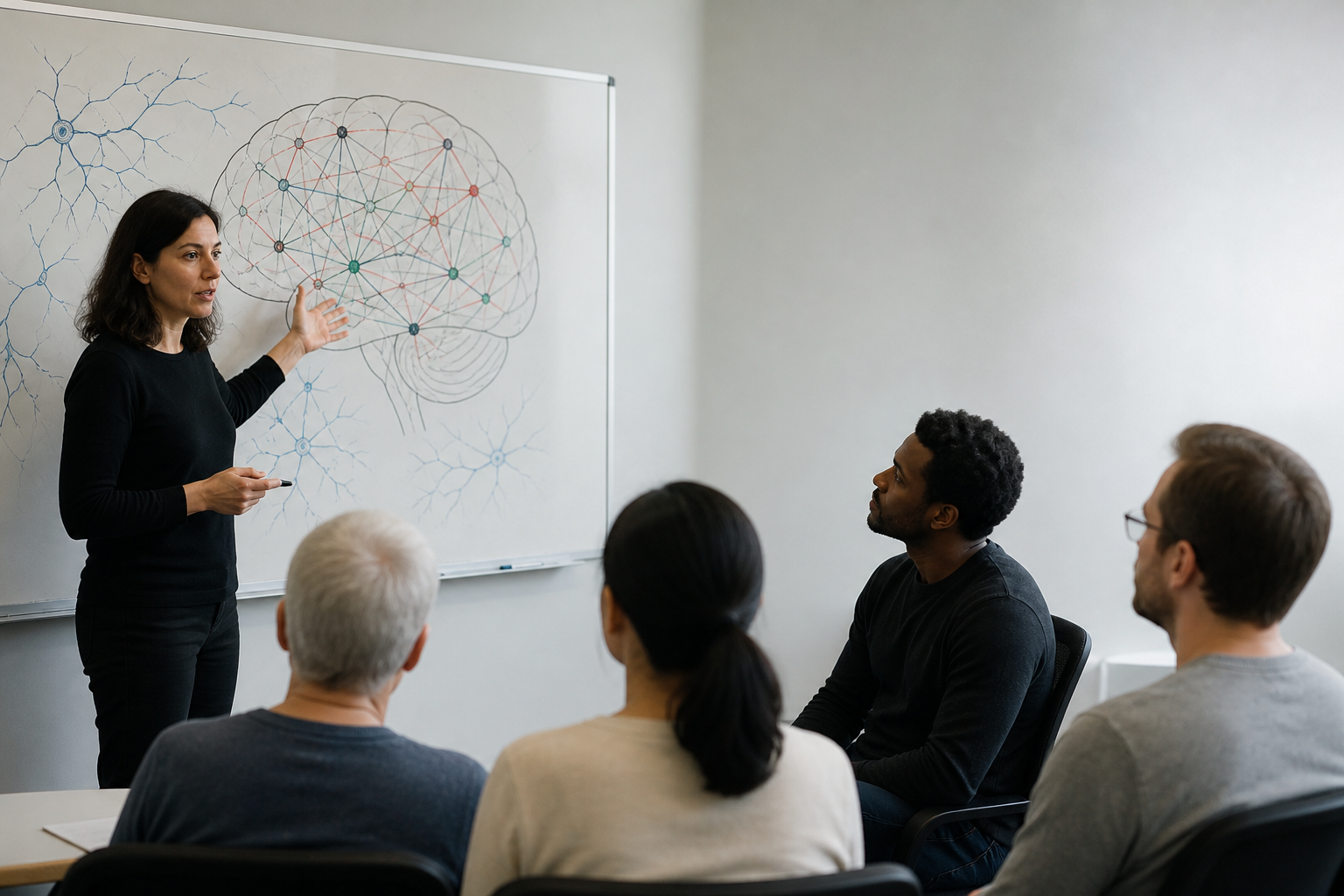
Barrett's alternative, which she calls the theory of constructed emotion, holds that no such fixed circuits exist. Instead, the brain is fundamentally a predictive system. It draws on past experience and memory to anticipate what incoming sensory signals mean, and it assembles an emotion from those predictions in context. "What is an emotion?" she told the Peter Attia MD podcast. "It's a set of predictions that tells a story about what a set of sensory signals mean to you in that situation."
On this account, there is no universal biological fingerprint for fear or sadness, because the brain is not reading out a pre-set program. It is constructing an interpretation.
What this would mean for everyday life
If emotions are constructed rather than triggered, the brain's predictions can in principle be changed. Barrett discusses with Attia how deliberate practice and new experiences can reshape those predictions over time, potentially shifting how a person thinks, feels and responds. She also describes how chronic stress, childhood adversity and the loss of close relationships affect what she calls the body's metabolic budget: the ongoing physiological work the brain does to regulate the body through a process called allostasis, meaning the brain's continuous anticipation and adjustment of the body's internal state.
The conversation covers grief specifically: losing a close relationship removes a source of nervous system regulation, which Barrett says has measurable physiological consequences.
What the evidence does and does not establish
This is a theoretical framework developed from decades of research, not a single clinical trial. The Peter Attia MD podcast summary does not describe the specific studies behind each claim, the sample sizes involved, or whether the predictions the theory makes have been tested in controlled experiments against the conventional model.
Barrett's theory is contested within neuroscience. The claim that there are no universal biological signatures for discrete emotions runs against a body of research that argues otherwise, and the podcast summary does not address that disagreement.
What the framework does offer, if it holds, is a shift in how agency over emotional life is understood: not as willpower applied against a fixed biological reaction, but as the gradual retraining of a predictive system. Whether that retraining is reliable, how long it takes, and in whom it works are questions the summary does not answer.
Anyone weighing whether this framework applies to their own situation, particularly around chronic stress or grief, would be better served by a clinician who knows their history than by a general theory, however well-supported.
Source: https://peterattiamd.com/lisafeldmanbarrett/
Life & Health Today provides information for educational purposes only, not medical advice, diagnosis, or treatment. Always consult a qualified healthcare professional.