Biohacking
Pufferfish taste receptor solves a structural puzzle about how flavor is sensed
By Life and Health Today Staff, . Life and Health Today.
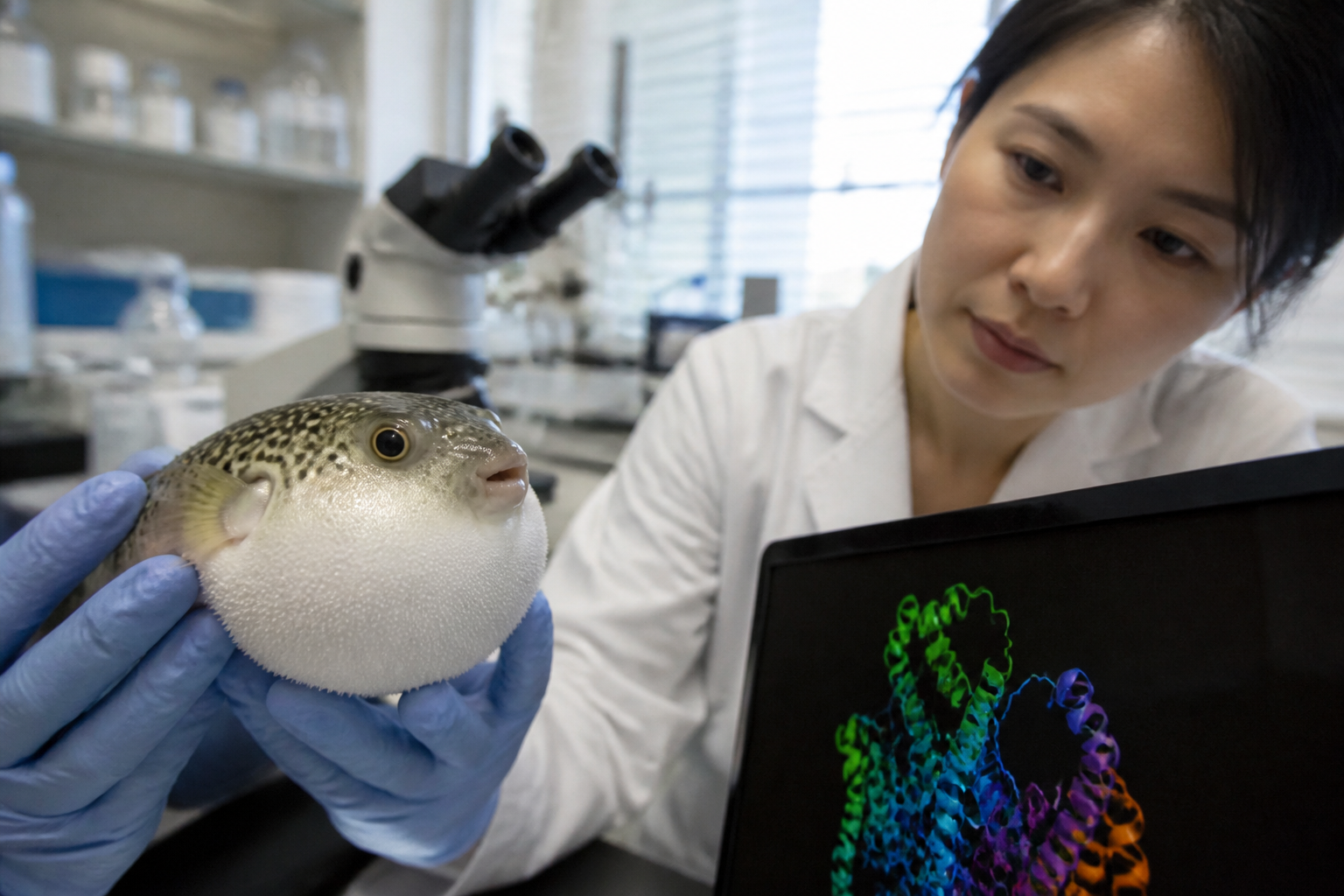
A research team led by the University of Osaka has determined the three-dimensional crystal structure of a taste receptor from the pufferfish Takifugu rubripes, and found something that does not fit the standard model of how taste works. The findings were published in the Proceedings of the National Academy of Sciences.
The receptor in question belongs to the TAS1R family, a group of proteins that sit on the surface of taste cells and act as molecular locks, recognizing specific nutrients and triggering the sensation of sweetness or savory flavor, known as umami. In humans and other mammals, these receptors are highly selective: the umami receptor responds to L-amino acids, which are the mirror-image form found in most proteins, while the sweet receptor responds to sugars and D-amino acids, the opposite mirror form. Getting the shape wrong means the receptor does not activate.
The pufferfish receptor breaks that rule. Using crystallographic analysis, a technique that fires X-rays at a crystallized protein to map its atomic structure, and mutational experiments that systematically altered parts of the receptor, the Osaka team identified what they describe as molecular latches: internal bridges within the receptor that brace its binding pocket shut even when an amino acid of the wrong mirror-image shape is present. That bracing keeps the receptor in its active state regardless of which form of amino acid is docked inside.
Senior author Atsuko Yamashita, quoted by Neuroscience News, described the finding this way: "Discovering how the Tas1r1/Tas1r3 receptor structure acts like a latch, holding either an L- or D-amino acid molecule in place, is an exciting breakthrough in understanding how receptors can evolve to be more flexible."
The team's explanation for why pufferfish evolved this flexibility is ecological. Pufferfish eat mollusks and crustaceans, which are rich in D-amino acids. Yamashita noted: "The ability to taste both forms may help the fish detect a wider range of savory amino acids in their foods."
What this does not show is anything about human taste perception directly. The entire structural finding is in a fish receptor, in crystallized protein samples, not in living animals and not in people. The paper, as reported by Neuroscience News, notes that vertebrate taste receptors share a conserved core architecture, which is the scientific basis for thinking the finding might eventually translate, but that translation has not been demonstrated.
The practical applications the researchers point to are in food science and aquaculture: using the structural blueprint to design new umami-enhancing compounds or feed additives. Those applications are speculative at this stage. Knowing the atomic structure of a receptor is the starting point for that kind of design work, not the end of it.
The open question is whether the latch mechanism the Osaka team identified exists in any form in human taste receptors, and if so, whether it can be deliberately engineered. That would require structural work on human TAS1R receptors, which the paper notes have been difficult to purify and stabilize in the lab. This pufferfish structure may make that work easier by providing a reference architecture, but the step from fish receptor to human flavor design is a long one and has not been taken yet.
For now, the finding is a structural biology result in a non-human species, published in a peer-reviewed journal, that changes how researchers understand the range of shapes a taste receptor can accommodate. That is a meaningful advance in the basic science of how animals sense food. What it means for anything a person might eat is, at this point, an open question.
Source: https://neurosciencenews.com/taste-perception-molecule-neuroscience-31223/