Regenerative
Lab-built bone marrow chip shows how antibody cells settle and survive
By Life and Health Today Staff, . Life and Health Today.
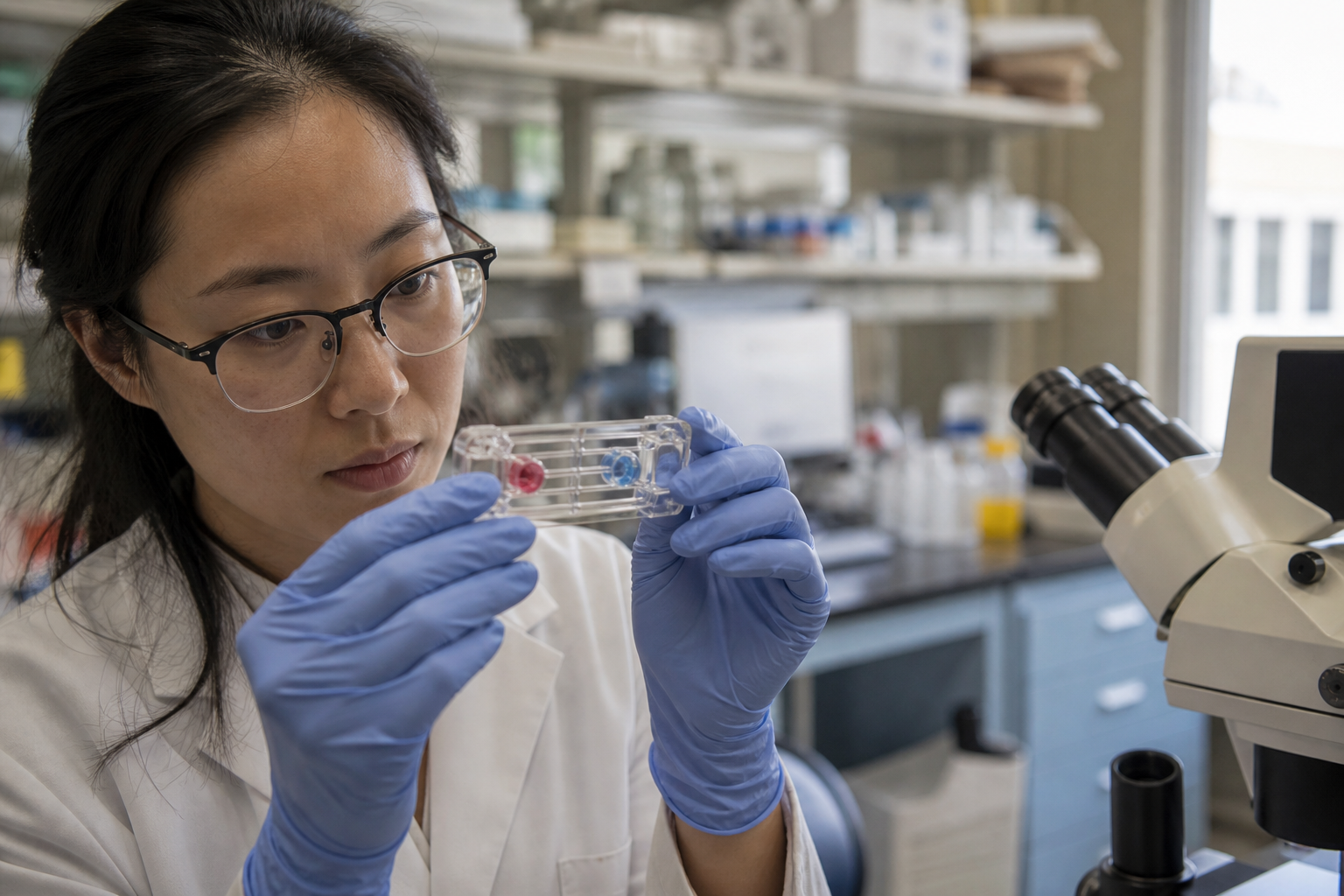
Scientists at Georgia Tech and Vanderbilt University, with funding from the National Institutes of Health, have built a laboratory model that replicates key features of human bone marrow on a chip roughly the size of a stack of credit cards. The work is published in the journal Science Advances.
The device is designed to study plasma cells, which are the specialised white blood cells that produce antibodies, the proteins the immune system uses to recognise and fight pathogens. Understanding where plasma cells go after they are made, and how they survive long-term, has been difficult because, as Georgia Tech professor Ankur Singh told Genetic Engineering and Biotechnology News, "it is nearly impossible to achieve high imaging resolution of plasma cells in living human bone marrow."
The platform has two parts. Singh's team built a lymphoid organoid, a small cluster of tissue grown in the lab to mimic a lymph node, by isolating B cells, the immune cells that eventually become plasma cells, from human tonsil tissue and blood. They used inactivated influenza virus to prompt those B cells to transform into antibody-secreting plasma cells, according to Genetic Engineering and Biotechnology News. Separately, the lab of Krishnendu Roy at Vanderbilt designed a microfluidics chip, a device that moves tiny volumes of fluid through miniature channels, to mimic the structure of human bone marrow.
The chip is assembled within a three-by-five stack of 96-well plastic plates, each less than half an inch thick, according to Genetic Engineering and Biotechnology News. Its channels are coated with a gel-like material containing nutrients and growth factors. Crucially, the model replicates two distinct zones inside bone marrow: the endosteal subniche, a region at the outer edge of the bone marrow cavity where plasma cells are stored, and the perivascular subniche, a deeper region surrounding blood vessels where plasma cells proliferate and are activated.
Reproducing those two zones matters because plasma cells do not behave the same way in both. A central question the study addresses, Singh said, is why B cells, once ready to make antibodies, leave the lymph nodes and spleen and relocate to bone marrow, and what role the bone marrow environment plays in shaping their response to reinfection.
What this does not show is whether the chip accurately predicts what happens in a living person. It is a laboratory model, not a human trial, and the gap between a chip and a body is significant. The developers acknowledge it is a "simplified model" intended to ask questions about organ-like behaviour, not to replace the organ itself.
The potential applications described by the researchers are also at an early stage. Genetic Engineering and Biotechnology News reports that the chip could be seeded with cells from older donors to study how ageing affects plasma cell function, or with cells from people with autoimmune or allergic conditions to examine how disease-promoting plasma cells are produced and maintained. Those are research directions, not findings yet.
What the platform offers right now is a way to run experiments that were not previously possible in human tissue. Whether the results it produces translate into insights that eventually reach patients depends on work that has not yet been done. Anyone with a clinical question about their immune health should raise it with a clinician who knows their history.