Biohacking
Mouse study maps the brain circuit that drives pregnancy food cravings
By Life and Health Today Staff, . Life and Health Today.
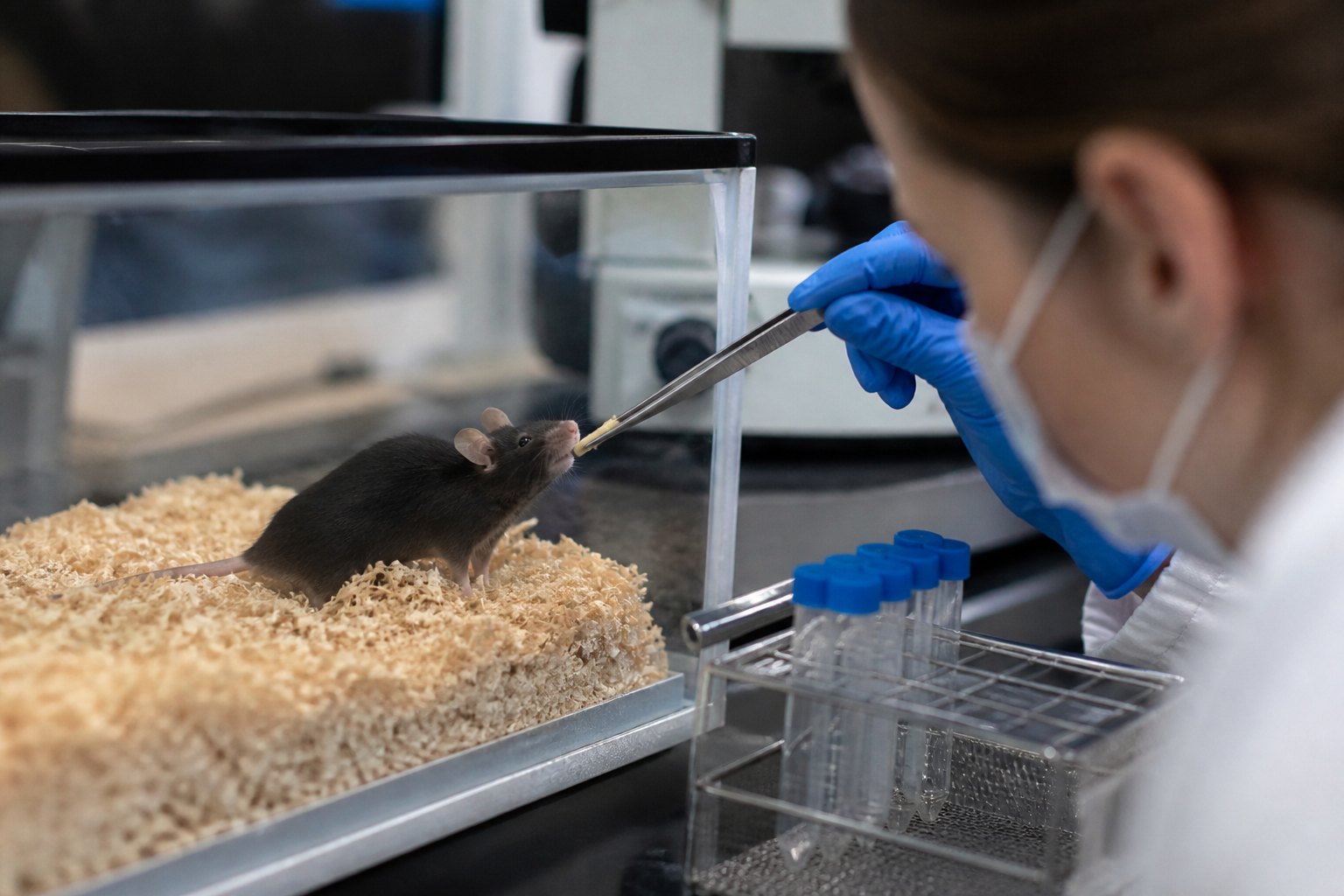
Researchers have identified a brain circuit that drives food-craving behavior during pregnancy, according to a study published in Nature Neuroscience. The work was led by Dr. Yanlin He at LSU's Pennington Biomedical Research Center, Dr. Pingwen Xu at the University of Illinois Chicago, and Dr. Chunmei Wang at Baylor College of Medicine. All of it was done in mice. That matters, and the authors say so plainly.
Here is what they found. During pregnancy, a type of ion channel called SK3, small conductance calcium-activated potassium channel 3, which acts as an electrical brake on neurons, becomes more active inside serotonin-producing cells in a brainstem region called the dorsal raphe nucleus. Serotonin is a signaling molecule involved in mood, appetite, and satiety. When SK3 activity rises, these serotonin neurons fire less. When they fire less, an inhibitory signal they normally send to the brain's reward center, the ventral tegmental area, or VTA, which drives motivation and reinforcement, gets weaker. With that brake lifted, the reward system amplifies the drive for calorie-dense, palatable food.
The team tested this in several directions. When they genetically removed SK3 channels from serotonin neurons in pregnant female mice, those neurons maintained their normal firing rates and the animals showed substantially less craving-like behavior. When they artificially increased SK3 activity in mice that were not pregnant, those animals developed the same drop in serotonin firing and the same craving-like behavior seen in pregnancy. And when they directly activated the pathway running from the dorsal raphe to the VTA in pregnant mice, food-seeking behavior decreased.
That is a coherent mechanistic story. The circuit runs in the direction the researchers predicted, and the manipulations worked in both directions. What it is not is evidence that any of this works the same way in humans.
"The findings are currently based in animal model studies, so we caution that directly manipulating serotonin during pregnancy could carry risks," Dr. He said, according to Neuroscience News. He also noted that future work needs to examine how pregnancy hormones like progesterone and estrogen interact with SK3 channels, and that translational clinical studies are planned.
What this does not show is whether the same circuit operates in human pregnancy, whether the degree of SK3 activity correlates with the severity of cravings in people, or whether any intervention targeting this pathway would be safe during gestation. Serotonin signaling is involved in fetal development, which is precisely why the authors flag caution rather than a path to treatment.
The clinical stakes are real. Neuroscience News notes that excessive cravings during pregnancy are associated with gestational diabetes, maternal obesity, and long-term metabolic complications for both parent and child. Understanding the biology is a legitimate first step. But a mouse model of craving-like behavior and a human experience of craving are not the same measurement, and the distance between them is where most preclinical findings stop traveling.
If this line of research moves into human studies, the questions worth watching are whether SK3 activity in serotonin neurons is measurable in pregnant people, whether it tracks with reported craving intensity, and whether any safe modulation is possible without affecting fetal development. None of those questions have answers yet. Whether a reader should do anything differently because of this study is a question for a clinician who knows their individual history, not a finding that this research can answer.
Source: https://neurosciencenews.com/brain-circuit-pregnancy-food-cravings-31222/