Regenerative
Two biotech firms are building shared tools to move cell therapies from lab to clinic
By Life and Health Today Staff, . Life and Health Today.
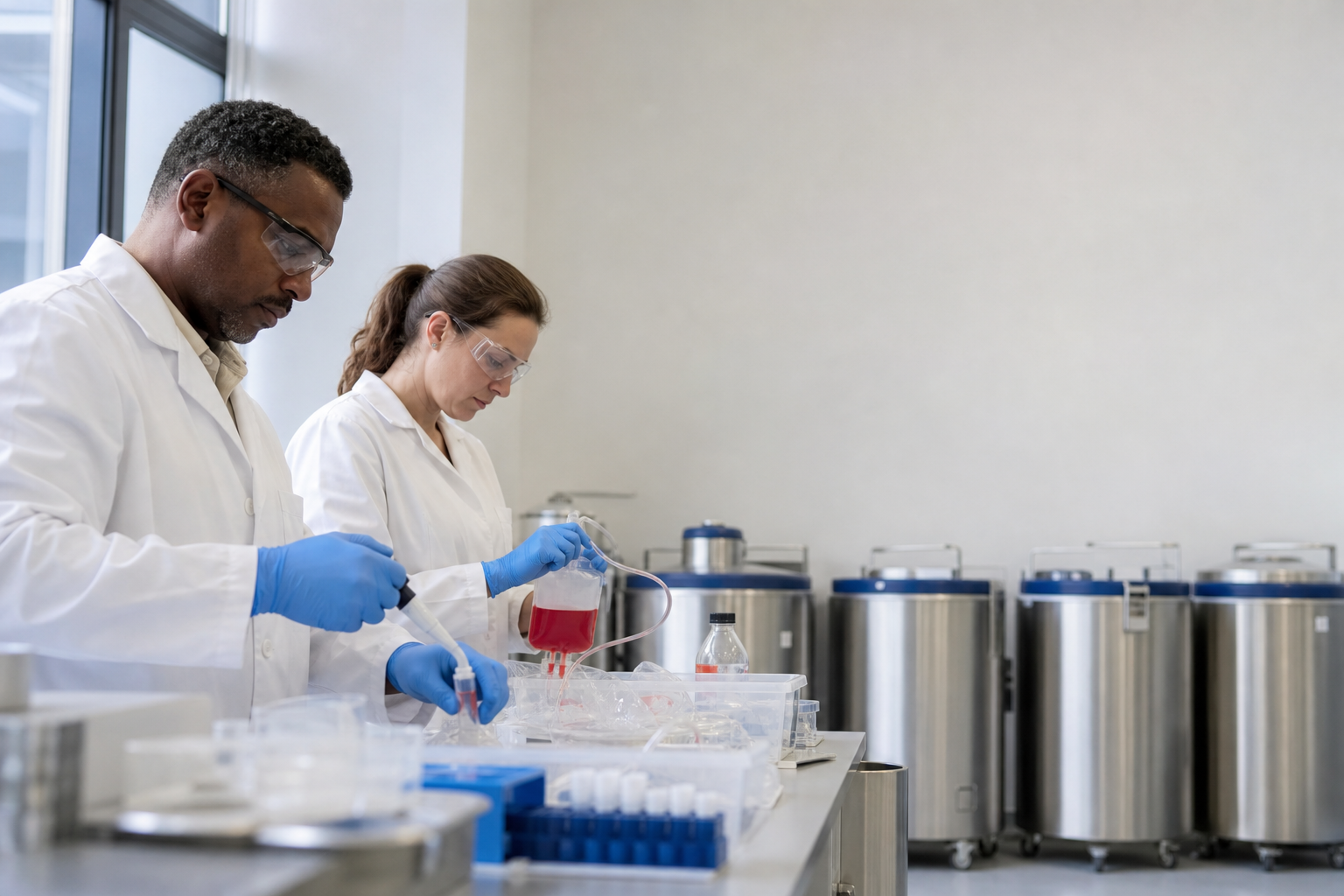
Getting a cell therapy from a promising laboratory result to a treatment that can be made consistently and given safely to patients is, in practice, a manufacturing problem as much as a scientific one. Two companies working on that problem, FUJIFILM Biosciences and Terumo Blood and Cell Technologies, described the state of their collaboration at the European Society of Gene and Cell Therapy's 33rd annual congress, held in Hamburg, Germany from October 27 to 30, 2026. The details were reported by RegMedNet.
What the partnership is actually building
The collaboration pairs FUJIFILM Biosciences' cell culture media, the nutrient-rich liquid in which cells are grown outside the body, with Terumo Blood and Cell Technologies' Quantum Flex Cell Expansion platform, an automated, modular system for growing large numbers of cells in a controlled way. According to RegMedNet, the two companies have spent years generating data together on how those two components perform in combination, and have used that foundation to develop a set of process liquids and media designed specifically for the Quantum Flex system, along with customized bag formats matched to different raw material requirements.
Gonçalo Regalo, Senior Product Manager for Cell Therapy at FUJIFILM Biosciences, told RegMedNet that modularity, the ability to swap and optimize individual steps in a manufacturing process rather than redesigning the whole thing, is central to the approach. "We can provide the right tools and reagents to optimize these modules and have full control of the critical quality attributes of the cell therapy product as it goes to the manufacturing process," he said. "This, for me, is essential in building processes and bringing products that are applicable and scalable to tackle these diseases."
Dr. Antje Kremer, Senior Manager of Global Market Development for Cell and Gene Therapies at Terumo Blood and Cell Technologies, pointed to the variety of cell types and disease areas the platform needs to support as the reason ongoing data generation matters. "Every cell therapy workflow is different," she told RegMedNet, "and developers need combined data they can directly apply to their own products, alongside the data they generate themselves."
What comes next, and what this does not yet show
RegMedNet reported that the companies' near-term plans include optimizing protocols beyond what their existing data covers, removing animal-derived serum from the manufacturing of mesenchymal stromal cells (a type of cell being studied for its potential to reduce inflammation and support tissue repair), and refining processes for expanding T cells, the immune cells used in many cancer therapies, under chemically defined conditions on the Quantum Flex platform.
None of this is clinical evidence. The partnership is about manufacturing infrastructure, not about whether any specific therapy built on it works in patients. What the two companies are trying to solve is a step that comes before a clinical trial can even begin at scale: making enough cells, consistently enough, to run one. That is a genuine bottleneck in the field, and progress on it matters, but it is a different kind of progress from a trial result.
The piece in RegMedNet was framed as a congress interview rather than a peer-reviewed report, and no independent data from the collaboration was published alongside it. What the partnership has produced in terms of measurable outcomes, and how it compares with other manufacturing approaches, remains to be seen in the published literature.
Source: https://www.regmednet.com/partners-in-progress-an-update-from-esgct/
Life & Health Today provides information for educational purposes only, not medical advice, diagnosis, or treatment. Always consult a qualified healthcare professional.